Challenge
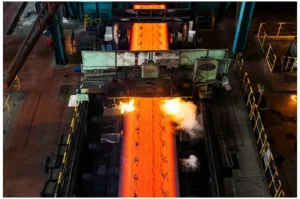
A new-materials plant in Yulin supplied by a 1000 kVA transformer operates three medium-frequency induction furnaces (one 300 kW and two 200 kW). The furnaces are thyristor-rectifier loads that inject harmonic currents (typically 5th, 7th, 11th and 13th order) into the plant network.
Since commissioning, the site suffered from frequent overload tripping of the capacitor compensation bank, severe overheating of the transformer and supply cables, and repeated fuse failures — disrupting production and affecting other users on the 10 kV bus. The utility repeatedly required the plant to treat the harmonic pollution.
Solution
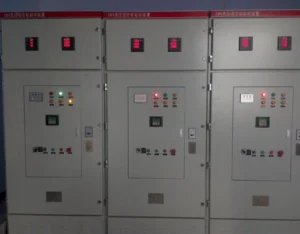
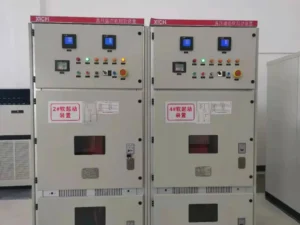
Two Xichi XCAPF-3L/100A active power filters (APF) were installed for harmonic mitigation. The APFs connect in shunt (parallel) with the supply, continuously detect the load-side voltage and current, and drive IGBT modules to inject compensating current equal in magnitude and opposite in phase to the harmonic current — cancelling the distortion in real time as the furnace load changes.
The XCAPF series is designed for rapidly varying loads and non-linear equipment, making it suitable for furnace duty. For more on our power-quality and motor-control product range, see our technical guides.
Results
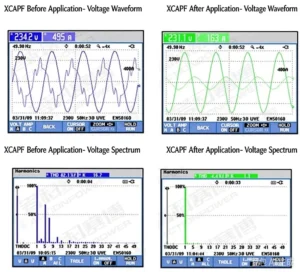
- Voltage THD reduced to below 4% after the XCAPF units were commissioned (site instruments measured 82.43% before and 4.41% after compensation)
- Harmonic currents met the requirements of GB/T 14549-93 (China’s utility harmonic standard, equivalent limits to IEEE 519)
- Field tests by the utility on both the 10 kV high-voltage side and the 380 V low-voltage side passed
- Line current drawn from the transformer dropped from 495 A to 163 A after compensation (site measurement)
- No faults on the supply system or equipment since commissioning; transformer and cable overheating relieved
FAQ
Why do medium-frequency induction furnaces create harmonics?
Medium-frequency furnaces are powered through thyristor rectifiers that draw current in pulses rather than smoothly. This non-linear load injects harmonic currents — mainly 5th, 7th, 11th and 13th order — back into the supply network, distorting the voltage waveform and stressing transformers, cables and capacitor banks.
What problems do furnace harmonics cause for capacitor banks and transformers?
Harmonic current flows preferentially into capacitors (lower impedance at high frequency), overloading them and causing protection trips, blown fuses and overheating. Capacitors can also resonate with system inductance at a harmonic frequency, amplifying the distortion. Transformers and supply cables overheat from the extra harmonic current, shortening their service life.
Active power filter vs passive or detuned filter: which is better for furnaces?
Passive and detuned filters are tuned to fixed frequencies and cannot follow a rapidly changing load. An active power filter detects the full harmonic spectrum in real time and injects equal-and-opposite current, so it keeps working correctly as the furnace load varies through the melting cycle — the right fit for furnace duty.
What THD limits apply to furnace installations?
In China the reference is GB/T 14549-93; internationally, IEEE 519 is the most widely cited standard, which typically limits voltage THD to 5% at the point of common coupling for general systems. In this project the utility’s field tests on both 10 kV and 380 V sides passed after compensation.
How was the THD verified in this project?
Site power-quality instruments measured voltage THD at 82.43% before the XCAPF units were commissioned and 4.41% after, with the plant confirming THD below 4%. The utility then ran field tests on the 10 kV high-voltage side and the 380 V low-voltage side, and the results passed.
Can multiple APF units be paralleled for higher furnace capacity?
Yes. APF units connect in shunt, so they can be paralleled to reach the required compensation current. In this project two XCAPF-3L/100A units (2 × 100 A) were deployed together for the three furnaces.