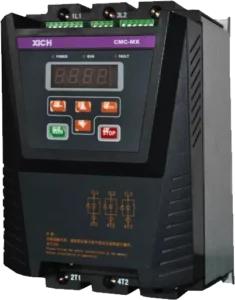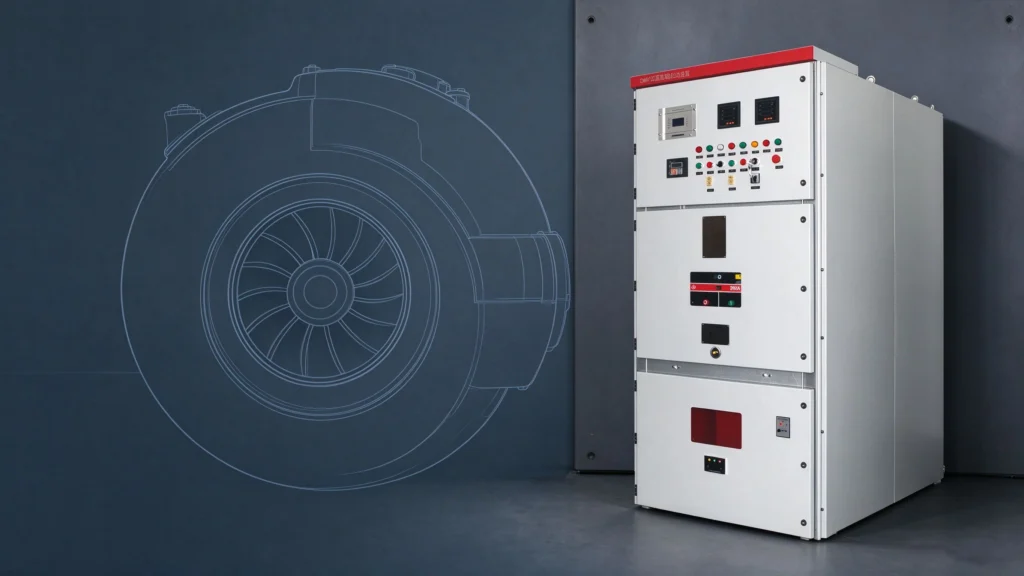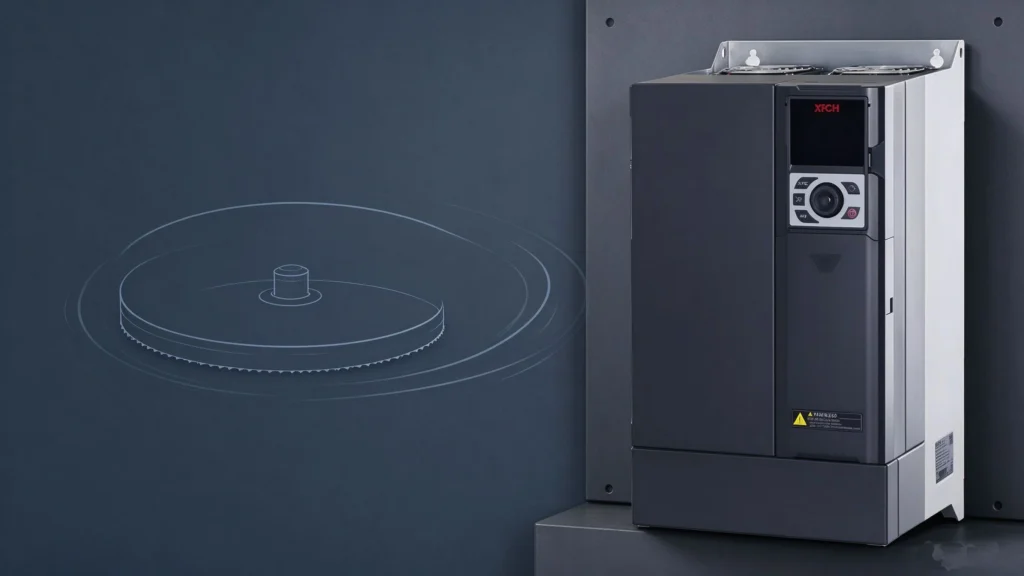
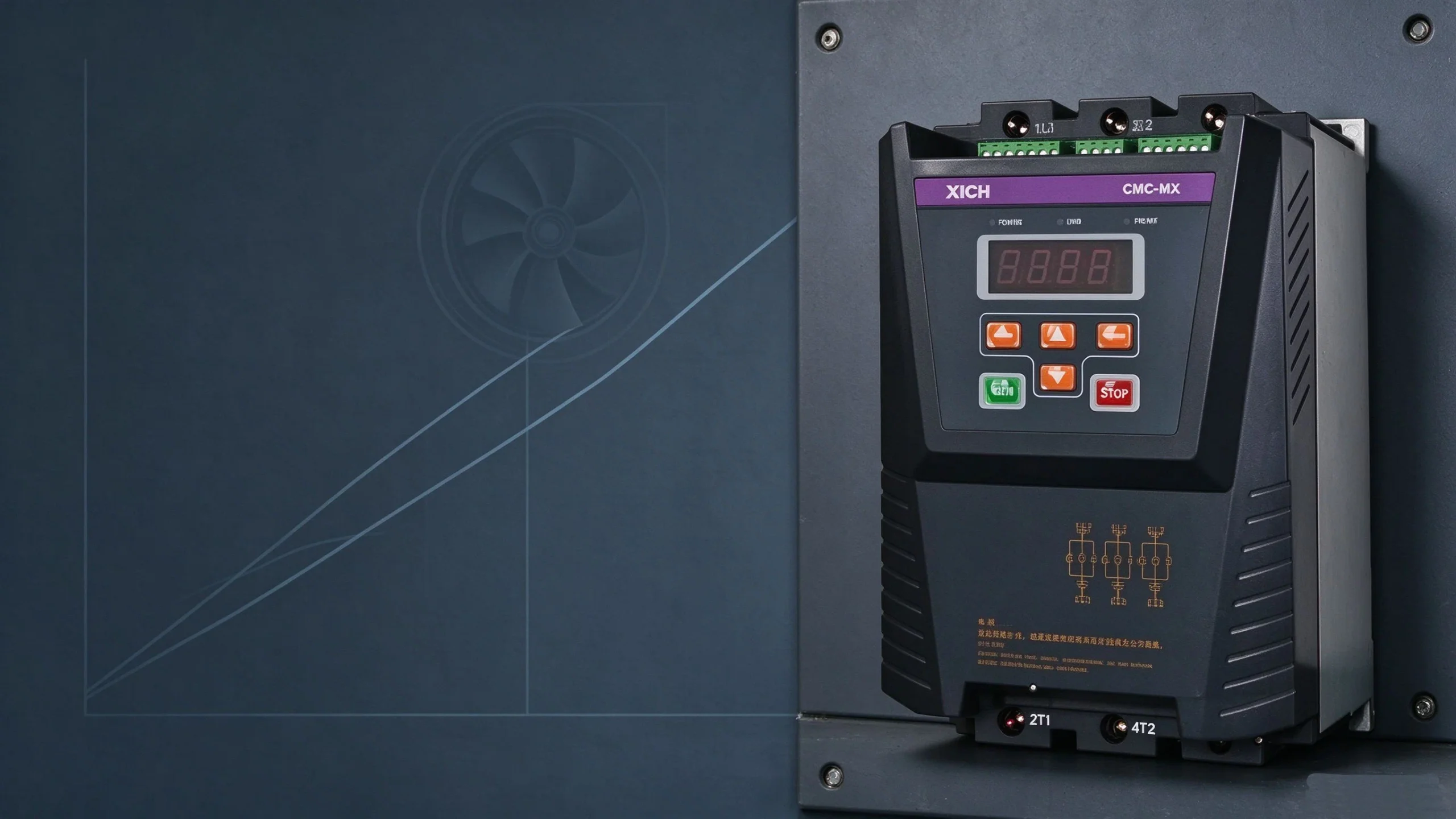
A soft starter is a modern motor starting device built on thyristors (SCRs) plus matching control software and hardware. It is formed by three pairs of anti-parallel SCRs connected in series; by controlling their firing angle it varies the input voltage and therefore the motor’s starting characteristic. When starting centrifugal fans, pumps and similar loads, the CMC-MX built-in bypass soft starter (380 V, 7.5–280 kW) brings many advantages over conventional contactor (DOL), star-delta and autotransformer reduced-voltage starting. Because its starting and running parameters are adjustable, installation, commissioning and operating conditions differ substantially from traditional motor starters.
1. Basic Soft-Starting Parameters
1.1 Comparison with Other Starting Methods
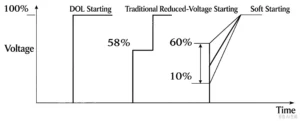
Direct-on-line (DOL), or full-voltage starting, draws about 4–7 times rated current, imposing a large shock on the supply and connected equipment. Small motors may use DOL; for medium and large motors exceeding 5%–25% of the supply transformer capacity, reduced-voltage starting (star-delta, autotransformer) is normally required. Reduced-voltage starting lowers the current but still produces current impulses that stress the grid and equipment.
A soft starter achieves stepless acceleration with a much weaker impact on the grid and equipment.
[Figure — Voltage vs time: DOL jumps straight to 100%; traditional reduced-voltage steps to ~58% then ~60% with steps; soft start ramps smoothly up from a low initial voltage (~10%) to 100%.]
1.2 Common Start Modes
The CMC-MX offers several start and stop modes; choose by load and site conditions.
(1) Current-limited start. Set ramp time to zero. On a start command, output voltage rises quickly until the output current reaches the set limit Im; current then holds. After the motor accelerates for a while, current drops and output voltage rises quickly to full voltage, completing the start. Best where starting current must be tightly capped.
(2) Voltage ramp start. Voltage rises linearly from low to full. Suited to high-inertia loads where starting smoothness is required; greatly reduces starting shock and mechanical stress — typical fan duty.
(3) Current ramp start. On command, output current rises smoothly at the set ramp time while voltage follows; when current reaches Im it holds constant until start completes. On light loads the current stays smooth and avoids motor oscillation.
(4) Kick-torque (pulse) start. For loads with high static friction. The output voltage quickly reaches a set kick voltage, holds for a set kick time to break loose the load, then starts smoothly from the set initial voltage / current and ramp time. Use together with another start mode and set both kick voltage and kick time.
1.3 Stop Modes
- Free stop: when soft-stop time and braking time are both set to zero, the starter blocks the bypass contactor control relay and then the SCR output; the motor coasts to a stop by inertia.
- Soft stop: with soft-stop time set, the bypass contactor opens first and output voltage ramps down to the set stop voltage over the soft-stop time; the unit then goes to braking (if braking time is set) or free stop.
- Braking stop: with braking time set and the braking relay output selected, the unit applies braking (via an external braking unit or mechanical brake control) during the set braking time.
- Soft stop + braking stop: voltage ramps down first, then braking follows.
1.4 Running States
- Across-the-line running: SCRs fully conduct and the motor runs at full voltage. Used for complete control systems needing soft start/soft stop, energy saving, fault protection, alarm and pre-set low speed.
- Bypass running: the soft starter works only during start and stop, reducing SCR thermal loss and extending SCR life; on a soft-starter fault the bypass contactor also acts as an emergency fallback. Note: when bypassed, energy-saving, protection, alarm and pre-set low-speed functions are no longer active.
2. Application on Fans
2.1 Fan Characteristics
A fan is normally a high-inertia load with a long ramp-up time, so direct-on-line starting works poorly.
2.2 Benefits of Soft-Starting a Fan
- Start time is adjustable from 6 to 120 s, meeting the fan’s long starting requirement.
- The fan starts under load with load torque rising roughly linearly; soft-start torque rises linearly with time, so the starting characteristic matches the fan.
- Lower starting current reduces grid impact.
- Lower mechanical shock extends fan service life.
3. Commissioning a Soft Starter on a Fan
3.1 Before Energizing
- Check motor insulation resistance BEFORE connecting the starter. The circuit contains SCRs; once the motor and starter are connected, using a high-voltage megger on the motor will damage the SCRs.
- Bar the fan (turn the shaft by hand / by the barring device) and confirm the motor rotates freely; if not, never start.
- Check parameters: voltage, current, power and motor pole count against the nameplates.
- Commissioning sequence: manual barring → control-circuit dry run → motor no-load run → loaded run.
- Choose start mode and time: for a given rating, the heavier the load, the longer the ramp; where grid quality is a priority, choose current-limited start, again with longer ramp for heavier load.
3.2 Energized Commissioning Cautions
- Motor does not start after the start signal: main or control circuit not powered; wrong control wiring; internal motor fault.
- Motor turns slowly then stops and the line protection trips: possible rotor lockage — clear the jam before restarting.
- Motor starts but trips shortly after: thermal overload set too low; motor pole count mismatch; fan air leakage. Remove the cause before restarting.
- Do not start frequently. Repeated high inrush can burn the SCRs. Plan on about 10–20 starts per hour, with 3–6 minutes between loaded starts.
4. Operation Notes
- Watch overvoltage to avoid motor damage.
- Avoid prolonged overload.
- Watch prolonged underload; if it occurs, readjust the thermal protection parameters.
Related field reference: for a real installation outcome on process fans, see the soft starter on fans at a Zhejiang environmental plant case study.