XFC500 VFD on a Rebar Cage Winding Machine: Application and Advantages

XFC500 VFD on a rebar cage winding machine: drive unit beside a faint spiral helix line motif on a dark industrial panel

💡Key Takeaways

  1. The machine uses friction-driven roller carriers plus a moving wire trolley to wind rebar spirally and weld.
  2. The XFC500’s wide speed range suits different cage processes and allows mid-cycle start/stop.
  3. Sensorless vector control gives strong low-frequency torque, linear speed setting and steady accuracy for consistent cage quality.
  4. Smooth soft start removes electrical/mechanical shock and extends machine life.
  5. AVR keeps output stable on long low-voltage or fluctuating supply.
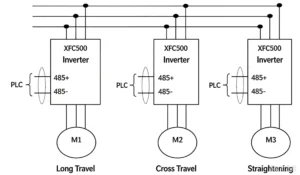
  6. Three drives — carriage, trolley, straightener — are coordinated over RS485 from one PLC.

1. What a Rebar Cage Winding Machine Does

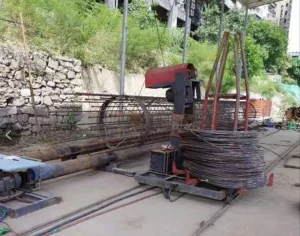
A rebar cage winding (roll-welding) machine works on the friction-drive principle: the cage lies horizontally between two sets of powered roller carriers that turn it, while a trolley carrying the rebar wire travels parallel to the main body at constant speed, winding the rib spirally. Welding happens during winding (or after a quick wind, then weld/tie) until the cage is complete.
The machine is highly automated, saves labor, processes stably and saves material. It is widely adopted on high-speed railways, highways, urban construction and road-bridge projects, and has become essential foundation-construction equipment.

2. Advantages of the XFC500 VFD on This Machine

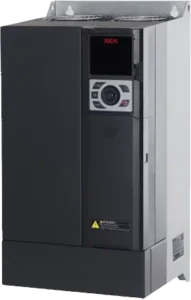
On this line, the XFC500 pump VFD (380 V, 1.5–450 kW) (see the full low-voltage VFD range) delivers:
  • Wide speed range, adapting to different process requirements.
  • Start and stop at any point mid-process.
  • Smooth soft start, avoiding electrical and mechanical shock and extending machine life.
  • Optimized sensorless vector control: strong torque at low frequency, good linearity of speed setting, high steady-speed accuracy — protecting the processing quality of the rebar cage.
  • Superior AVR (automatic voltage regulation): strong grid adaptability for sites with chronically low or fluctuating supply, keeping output voltage and current stable.
  • Simple system control and easy commissioning.

3. System Wiring

Three XFC500 drives communicate with the PLC over RS485 (485+/485-):
  • M1 — main carriage (host rotation)
  • M2 — moving trolley (wire feed)
  • M3 — straightener
Three XFC500 VFDs controlled by one PLC over RS485: M1 main carriage, M2 trolley, M3 rebar straightener wiring diagram

4. Site Photos

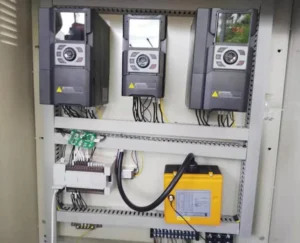
XFC500 VFDs installed in a rebar cage winding machine control cabinet with PLC wiring
Rebar cage winding machine on site: roller carriers turning a spiral rebar cage

10 kV Soft Starter on a Centrifugal Compressor: CMV-750-10 Case

A CMV-750-10 medium-voltage soft starter starts a 10 kV, 52 A, 4-pole centrifugal compressor with 45% initial voltage, 3.5× current limit and a 15 s ramp

XFC550 VFD on a High-Speed Disperser: Paint and Ink Application

The XFC550 VFD on a 7.5 kW high-speed disperser gives terminal start/stop, a 0–10 V speed signal, 10 s accel/decel and V/F control — steady shear

XFC500 VFD on a Rebar Cage Winding Machine: Application and Advantages

The XFC500 VFD on a rebar cage winding machine delivers wide speed range, smooth soft start, strong low-frequency sensorless torque, AVR grid adaptation and RS485 PLC